
Research Reports
The New (Renewable) Energy Tyranny
In recent years, California’s energy system has failed the state’s communities in almost too many ways to count: utility-caused wildfires, utility power shutoffs, and skyrocketing utility bills, for starters. Currently, state energy institutions are advancing an all-out effort to suppress local community ownership and control of energy resources—the decentralized energy model.
Instead, they are promoting and enforcing an outmoded, top-down, utility-centered, extractive, and unjust energy regime—the centralized energy model—which effectively eliminates local energy decision-making and local energy resource development. This model forces communities to pay the enormous costs of unneeded transmission line construction and bear the massive burden of transmission line failures.
Using the power of the state to enforce the centralized energy model is at the heart of California’s new renewable energy tyranny. And this tyranny has now spread to the federal level, as substantial public investment is now set to go toward large-scale renewable energy projects across the country.
These projects will be controlled by and benefit an increasingly powerful renewable energy oligarchy. Being touted as a solution to what is popularly regarded as the “climate emergency,” this centralized energy model has actually failed to meet our communities’ energy needs, and at the same time has exacerbated systemic energy injustice.
Community Choice Energy: Democratizing Municipal-Scale Power
On June 21, 2016, Pacific Gas and Electric (PG&E), the largest electrical utility in California, and one of the largest in the country, announced that it would be shuttering its Diablo Canyon nuclear power plant, the last remaining nuclear facility in the state.
In announcing its decision to forego operation of the plant beyond its current 2025 license, PG&E referred to a number of factors that capture the rapidly changing electric power landscape in the state and across the country. It cited new developments that “will significantly reduce the need for Diablo Canyon’s electricity output.” These included state mandates for renewable energy and energy efficiency and the growth of distributed energy resources. But PG&E also cited “potential increases in the departure of PG&E’s retail load customers to Community Choice Aggregation.” Hidden in that brief mention, is a pitched battle that has been taking place in California over recent years between advocates of community-controlled renewable energy systems and the state’s three investor – owned monopoly utilities. In announcing the 2025 closure of Diablo Canyon, PG&E essentially admitted that it is losing that battle, acknowledging that due to the expected loss of customers to Community Choice energy programs in California, there would be insufficient demand in the future for PG&E’s nuclear power.
So what is Community Choice energy, and what is its potential for establishing a new energy model that can democratize energy, both in California and in other states?
Toward a Climate Justice Energy Platform: Democratizing Our Energy Future
In response to the increasingly serious impacts of climate change, people around the world are attempting to wrest control of energy resources from the powerful institutions that are hell-bent on driving humanity to the brink of extinction.
The growing popular movement to address the world’s climate and economic crisis is widespread and takes many forms. Yet all reflect an effort by concerned citizens to exercise more control over energy decisions and to self-determine a sustainable, life-supporting energy future.
While this effort is expressed in the movement to confront and stop increasingly extreme fossil fuel extraction, shipment, and consumption, and to transition to a 100% renewable energy system, its most powerful expression is in advocating for an alternative to the energy establishment’s centralized, corporate, utility-scale renewable energy model. That alternative is a decentralized, democratized, community-based renewable energy model, one aligned with a climate justice strategy for addressing our current climate and economic crisis.
This paper is offered as a contribution to a national discussion regarding an energy platform that would strengthen the climate justice movement in the United States and propel development of the recently-formed national Energy Democracy Project.
East Bay Community Choice Energy
Communities across California are seeking ways to address the impacts of climate change and boost their local economies. Many are exploring Community Choice energy as a vehicle for achieving these objectives. Community Choice is a means by which city and county governments can aggregate or cluster electricity customers to provide electricity and related energy services. As a result, the local community can shape the program to prioritize desired benefits. For example, a Community Choice program determines the source of its electricity, so it can focus on a higher level of local renewable energy sources if that reflects what the community values. A Community Choice program can be a true energy service provider, integrating energy supply with demand reduction in a manner that meets community goals related to climate action, employment creation, price stability and local control. Accordingly, electricity customers will have an alternative provider option to the incumbent investor-owned utility. An example development scenario and proforma financial analysis included in this study shows that an East Bay Community Choice energy program encompassing Alameda County could lead to the following results withi
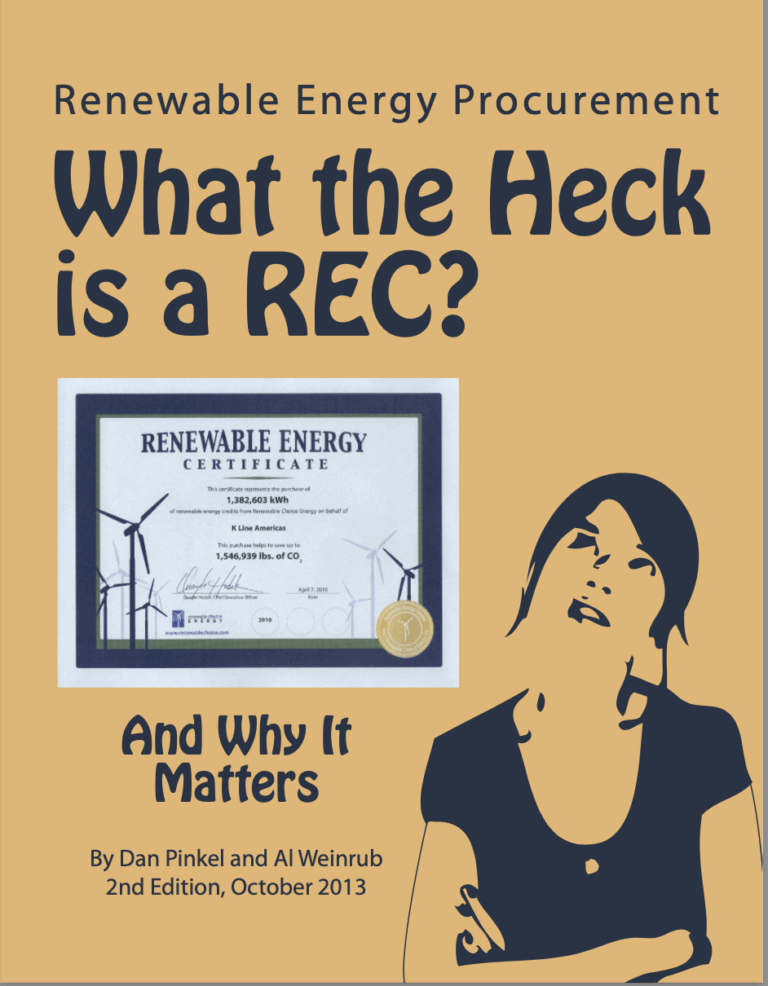
What the Heck is a Rec?
This paper is meant to be useful to clean energy advocates by providing information about California’s renewable energy requirements and the use of Renewable Energy Certificates (RECs)—sometimes called Renewable Energy Credits—to meet them. The information is relevant to other states, as well.
The information is particularly important for advocates of Community Choice energy programs. Community Choice energy, provided for by California’s AB117 (2002), enables cities and other jurisdictions to choose where the electricity provided to their residents and businesses will come from. This means that local communities can decide to procure their electricity from renewable energy sources: either by purchasing renewable electricity on the market, or more importantly, by developing local renewable energy resources in the community. Under a Community Choice energy program, the incumbent investor-owned utility company continues to deliver electricity and service customers.
A Community Choice energy program, even one prioritizing the development of local renewable energy resources, needs to purchase electricity on the market as it builds local energy efficiency and new generating assets. Throughout its development the program must comply with the California Renewables Portfolio Standard (RPS), which specifies the proportion of electrical energy sold that must come from qualifying (RPS-eligible) renewable sources.
Furthermore, California, like other states, has mandated that compliance with its RPS be documented through the use of RECs, and has set particular criteria that RECs must meet to count toward satisfying greenhouse gas reduction goals. As we discuss below, there are substantial differences among RECs, and their impact on renewable energy development can be highly variable, especially for RECs that do not qualify as meeting state RPS criteria. Meeting, or even exceeding, RPS requirements is measured by tracking RECs through various kinds of transactions. Hence an understanding of the RPS, RECs, and their relationship is needed in advocating for, designing, or evaluating Community Choice or other procurement programs. The same general considerations apply to evaluating renewable energy claims of utility companies and other electricity providers, both in California and in other states as well.
Community Power: Decentralized Renewable Energy in California
Every day brings new urgency to ending our dependance on fossil fuels. The extraction of these fuels is increasingly undermining the ecosystem upon which we humans depend; and the consumption of these fuels is responsible for many harmful pollutants, including the greenhouse gas emissions that are already impacting the climate, the entire biosphere, and our communities. A transition from fossil fuels to renewable energy is necessary if human beings and many other species are to survive. Our challenge is daunting. We must drastically reduce the amount of energy human society derives from carbon-based fuels. This is especially so in the United States, which ranks among the highest in total and per capita energy consumption, and which is responsible for the largest historical greenhouse gas emissions.